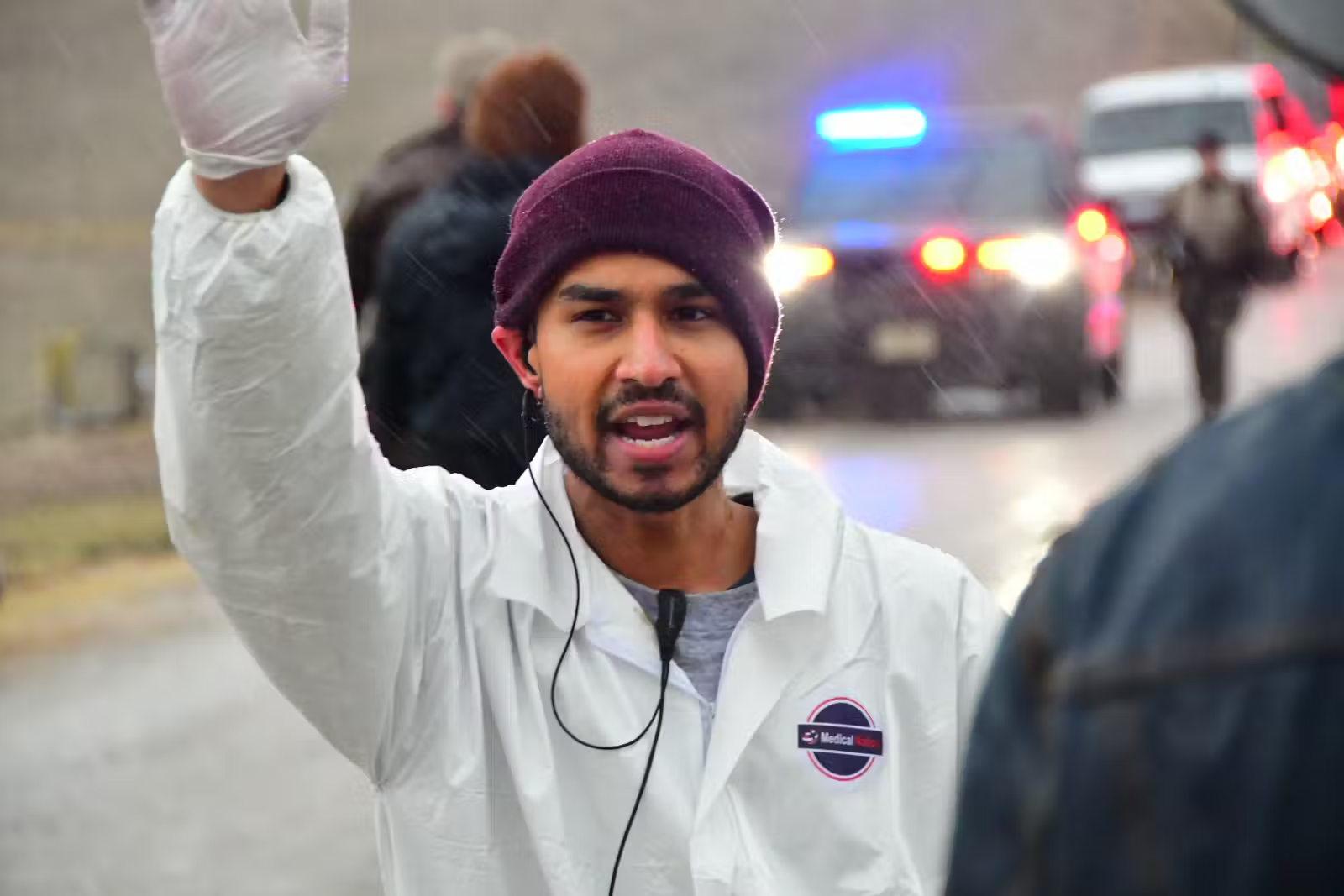
The Activist Defense Toolkit Outline sets out the key information for animal activists partaking in nonviolent direct action. Activists should consult this outline to better understand the nature of government repression, and how to effectively harness that repression to create change. This knowledge is critical for our movement to continue scaling in the face of government repression.
This outline primarily focuses on the legal aspects of activist defense, and sets out best practices through two decades of experience.
The toolkit is not a mandatory or exhaustive checklist; it is a useful guide.
This toolkit should not be used to deter people from activism by making things too complex or scary!
Open rescue is the animal rights movement's central form of nonviolent direct action. In this act, activists directly enter facilities of violence—such as laboratories, factory farms, or slaughterhouses—to document conditions and rescue distressed animals.
Since open rescues are performed openly, activists are often charged for their actions. For example, in America, three open rescue activists have been jailed, and dozens more have been charged with felonies. (The vast majority of the activists who have been charged accepted misdemeanor plea deals or diversion agreements that resulted in no jail time or serious penalties.)
Open rescue and the ensuing criminal trials have been one of the movement's most effective strategies for mobilizing supporters, attracting media attention, and amassing public support. Open rescue also creates opportunity for systemic reform by establishing the legal right to rescue animals from harm.
For example, some of the largest and most powerful animal abusers have been shaken by open rescues:
- The largest pig farm in the nation, Circle Four Farms, faced intense public scrutiny and was effectively shut down in 2022 after an open rescue in 2017, and an ensuing trial in 2022.
- One of the nation's largest vivisection facilities, Ridglan Farms, has faced global protests and became the subject of an animal cruelty prosecution after activists rescued beagles and had their charges dismissed in early 2024.
- The largest slaughterhouse in the Western United States, Farmer John, shut down after numerous protests, investigations, and a mass open rescue attempt in 2021.
Thus, while the information contained in this outline applies to many forms of nonviolent direct action, it is specifically tailored to the open rescue scenario.
Government repression in the form of prosecution, incarceration, or other, may chill a movement by deterring supporters from taking further action. This is what happened during the Green Scare of the early 2000s, where animal activists were tried and convicted of domestic terrorism.
In some cases, however, activists may harness the repression they suffer and cause it to backfire against their opponents. The civil rights movement was particularly effective at this in its Birmingham campaign. Thousands of people were arrested, triggering a national reckoning on race and segregation that paved the path to the Civil Rights Act of 1964.
Using the power of nonviolence, the animal rights movement is capable of triggering a similar, moral reckoning. But in order to pull this off, we must increase our movement's capacity. Part of this capacity building project involves understanding the nature of legal repression so that when it strikes, we are prepared to harness it on the animals' behalf.
Harnessing legal repression is particularly important in the animal rights context because animals lack “legal standing.” Most courts see them as invisible to the law, akin to chattel slaves from a prior era.
Thus, by pushing open rescue cases into court, activists leverage their own freedoms to advocate for animals' freedoms.
Ultimately, all of this work is in service of the greater vision of animal rights. Together, we can mend our relationship with fellow animals, transforming it from one of violence to one of kindness.
The Animal Rescue Coalition has set forth a 25-year timeline to establish constitutional rights for animals; harnessing legal repression is a crucial component of that timeline.
The Harvard Law Review recently published an article describing this theory of change, by open rescue leader and ARC co-founder Wayne Hsiung.
Open rescue activists are usually not charged with criminal offenses. It is typically only during high profile investigations or mass actions that criminal charges are brought, and these charges typically only target team leads. It generally takes a surprising amount of effort to get arrested and charged, as the industry does not want the attention brought by such charges.
Of the 500+ activists who have participated in open rescue, the vast majority have faced no legal consequences. Most activists who have been charged were charged only after their insistence, e.g., because they refused to leave a location where animals were being abused. Among those charged, the vast majority have accepted plea bargains that involve no jail time. Only three activists in open rescue history have faced jail sentences, all of which were about one month.
To further mitigate the likelihood of criminal charges, activists in mass actions may select among three varying levels of risk—high-risk, medium-risk, and low-risk—based on their personal risk tolerances.
These risk levels are often designated in easy to remember ways, e.g., with a breed of dog, season, or color associated with each team.
High-risk activists risk felony-level charges and are generally the team members who directly enter buildings and remove animals. These activists often remain on the facility's premises until they are arrested and receive the most training for actions.
High-risk activists are often broken down into smaller teams to facilitate more intensive training and more effective coordination on the day of action.
Charges that could be filed against high-risk activists include burglary (generally a felony), theft (potentially a felony, depending on the “value” of what has been “stolen”), and conspiracy.
There is a difference between charges on arrest, and charges that are ultimately filed. The charges on arrest are based on the police's suspicion of a crime that may have been committed. The charges that are ultimately filed are those that are brought by the prosecutors after a review of the evidence. It is often the case that charges on arrest are significantly more serious than charges that are ultimately filed in protest cases, as the police attempt to “over-charge” activists to deter them from taking future action.
In most prior mass actions, however, even high-risk activists have not been arrested or charged, even when the activists refuse to leave the facility. A typical response is for the authorities to allow everyone in a mass action, including high-risk activists, to leave and only arrest those who refuse to leave. Even among the group refusing to leave, prosecutors have not shown much willingness to aggressively charge large numbers of activists; they typically focus on perceived leaders and dismiss the charges, or offer favorable deals, to all the others. Progressive jurisdictions in particular have tended to avoid charging activists who are acting nonviolently and have legal arguments to back them.
Prior examples:
- Mings Poultry (San Francisco) — 1 out of 10 high-risk activists, Wayne Hsiung, was arrested on misdemeanor charges after he refused to leave the slaughterhouse. Those charges against Wayne were never filed. Six hens were rescued.
- Saba Live Poultry (Oakland) — 22 high-risk activists were arrested on misdemeanor charges (out of around 50 who entered the facility) after they refused to leave the slaughterhouse. The charges were never filed against any of those activists. Three animals (a goat, quail, and rabbit) were saved.
- Sunrise Farms (Petaluma) — 40 high-risk activists (out of around 100 total) were arrested on misdemeanor charges after they walked back onto the property through a police line in an effort to save more birds. Only 1 activist was ultimately tried and convicted on any charges, felony or otherwise (Wayne Hsiung). The remaining activists either had charges dropped or accepted “deferred entry of judgment” plea deals that involved no criminal conviction. 37 birds were saved.
- Petaluma Poultry (Petaluma) — 58 activists were arrested on felony charges after removing animals and setting up a veterinary tent to care for them on the property of a factory farm. All charges in this action were ultimately dismissed, probably due to the company's public relations concerns about prosecuting the activists. One bird, Rose, was rescued and lived a happy life after an officer on site allowed her to be removed from property.
- Reichardt Duck Farm — 78 high-risk activists were arrested on felony charges. All charges were ultimately dismissed or ended with deferred entries of judgment. 32 ducks were saved. (1 low risk activist, Wayne Hsiung, was convicted of misdemeanor trespass for this action.)
Medium-risk activists are activists who generally risk misdemeanor charges by stepping foot onto a facility's property. These activists do not enter barns or remove animals. Their role is to bear witness and provide support for activists who are directly rescuing animals. Historically, activists at this level have: provided water and aid to animals who have been removed by high-risk activists; accompanied high-risk activists upon entry and exit of a facility's property (in some cases entering buildings, but not removing animals themselves); and de-escalating any tensions with facility employees or police using nonviolent communication.
Medium-risk activists will generally be a part of a single large group, led by a team lead. They will not have individualized training or briefing, and the primary required training is attending a nonviolence training by DxE, The Simple Heart, or another approved organization.
Medium-risk activists have rarely faced arrest, much less charges, if they choose to leave the facility when officers instruct. Out of hundreds of medium-risk activists, none have ever been convicted of a crime.
However, in one prior mass action, Petaluma Poultry, medium-risk activists were arrested and initially charged with felonies. All charges in relation to this action were ultimately dismissed. This was most likely because of the company's public relations concerns about the sick and distressed animals found on site.
No medium-risk activist has ever faced trial or been convicted of a crime. Some medium-risk activists from the Petaluma Poultry action ultimately accepted deferred entry of judgment agreements. However, this was only demanded of activists who had a prior arrest history in the same jurisdiction.
Low-risk activists are activists who support the action from public property. They are the face of the action to the media, provide support when higher risk activists leave a facility, and de-escalate tensions by serving as the peaceful core of an action.
Low-risk activists are led by one or more team leads on public property. They do not require any training, but it is strongly recommended that they attend a nonviolence training.
With the exception of Wayne Hsiung at Reichardt Duck Farm, low-risk activists have never been arrested or charged pursuant to a mass action.
The most common criminal charges resulting from open rescue are at the state level. These charges may include trespass, theft, burglary, conspiracy, or animal-specific offenses such as “unauthorized release of animals.” Charges at the federal level are more rare, however they are still possible, and most likely to fall under the Animal Enterprise Terrorism Act. Each charge is discussed in further detail below.
Every criminal offense has certain “elements” that must be satisfied in order for a defendant to be convicted of the offense. Specific elements may vary from state to state; however, for the most part, they remain the same. Below are the elements of the criminal charges most commonly associated with open rescue.
1. Trespass
- Unauthorized entry onto property
- With the intent to enter or remain on property
- With notice that entry onto property is unauthorized
- Notice may be communicated via verbal communication, signage, or fencing
- Not all jurisdictions require notice as an element of trespass
2. Larceny (theft)
- Unlawful taking of another's property
- Generally, the property must have some commercial value, so the taking of sick animals does not constitute theft
- With the intent to permanently deprive the owner of said property
- In the open rescue scenario, the “property” is the rescued animal
- If activists believe they have the right to take an animal, either because the animal is sick and valueless, or because there is a right to rescue, the intent element often cannot be proven.
3. Burglary
- Unlawful entry into a building
- With the intent to commit a crime therein
- The crime committed therein is usually theft (rescue) of an animal
- If there is no intention to commit a theft, there can be no burglary. The defenses to theft therefore can be defenses to burglary.
4. Conspiracy
- An agreement between two or more people to commit a crime
- With the intent to commit the crime
- With at least one co-conspirator taking an “overt act” in furtherance of the agreement
- An overt act is a clear and observable action to further the conspiracy (e.g., purchasing a gun for a planned robbery)
5. Animal Specific Offenses
The elements of animal specific offenses vary state by state, and statute by statute. Typically, these offenses prohibit releasing animals from facilities, or facilitating the spread of zoonotic disease.
6. Animal Enterprise Terrorism Act (AETA)
- Damaging or interfering with the operations of an animal enterprise
- AETA is written very broadly. To date, however, it has never been used to charge an open rescue activist.
- AETA has been used to charge animal activists engaged in other activities, though. For example, in 2006, six activists associated with the historic SHAC campaign were convicted under the Animal Enterprise Protection Act—the predecessor to AETA—and sentenced to multiple years in prison. (Notably, the SHAC campaign can be distinguished from open rescue in that it involved property destruction.)
This section discusses the legal defenses used to combat criminal charges arising from open rescue.
These defenses are strong, however they do not guarantee a defendant's acquittal at trial. For example, of the five open rescue trials in the last decade, two have resulted in acquittals, while three have resulted in convictions.
The necessity defense, also known as the “choice-of-evils” defense, justifies someone's lawbreaking activity if it is to avoid a greater harm.
A classic example of the necessity defense is breaking into a building to escape a fire. This commits a lesser crime (trespass) in order to avoid a greater harm (being burned alive).
The necessity defense can also be invoked on someone else's behalf. For example, the necessity defense justifies breaking a car window if a child is overheating within.
The necessity defense also applies to the open rescue scenario. Since animals in agriculture and research are often in immediate need of care, activists are justified in trespassing onto these facilities to conduct rescues. This is often referred to as the “Right to Rescue.”
While the exact elements of the necessity defense differ by jurisdiction, they are generally set out as follows:
- Imminent harm. Someone is facing actual and imminent harm.
- No reasonable alternative. Breaking the law is the only way to prevent the imminent harm. This requires proof that all legal alternatives—such as notifying the authorities—have been exhausted.
- Reasonable belief. The defendant must reasonably believe that their actions are necessary to avoid the greater harm.
- Lesser evil. The evil of the lawbreaking itself must be lesser than the evil prevented by the lawbreaking.
In some jurisdictions, an element of larceny is that the stolen property has some “value.” Thus, if the stolen property has zero value, then the defendant cannot be convicted of larceny.
Value is typically defined as the stolen property's market value.
In the open rescue scenario, “lack of value” is often used as a defense when activists rescue animals from the brink of death. Since these animals are sick and unfit to enter the food supply, they are of no market value to the farm owner.
The lack of value defense was successfully invoked during the Smithfield Trial. Because the rescued piglets were on the brink of death—and thus lacking in market value—the jury moved to acquit the defendants of burglary.
A related defense is the defense of abandonment. This defense states that property cannot be stolen if it has been abandoned by its owner. In the open rescue context, animals left to starve to death are presumed to have been abandoned.
Under the criminal law, conviction typically requires more than just a criminal act. To be convicted, the defendant must also possess the requisite criminal intent.
In prior cases, the following arguments have successfully demonstrated lack of criminal intent:
- Theft. The defendant only had the intent to rescue sick animals. Thus, the defendant lacked the intent to steal property of value.
- Burglary. The defendant only formed the intent to rescue animals upon seeing distressed animals inside the facility. Prior to entering the facility, the defendant's sole intent was to document conditions.
- Mistake of Law. Prior to the action, the defendant consulted with a lawyer who affirmed the validity of the necessity defense. Thus, the defendant was acting under a good faith belief in the legality of their actions.
Prior to an action, it is very important to find the right lawyer. This lawyer should be competent, dedicated, and movement aligned. Most importantly, this lawyer should serve as a guide to the legal system, not a gatekeeper who “tells activists what to do.”
Most criminal defense lawyers are not skilled at activist defense because they rarely, if ever, represent someone who is proud of their alleged lawbreaking. Thus, criminal defense lawyers are taught to sow doubt in a jury. Activist defense lawyers, in contrast, must inspire the jury to make a decision of conscience.
In the past, open rescue defendants have experienced severe conflicts with their criminal defense lawyers. Typically, these conflicts arise from lawyers' traditional, criminal defense trainings, which instill cautionary and secretive reflexes. These reflexes are at odds with an open rescue case, where the defendant intends to be fully transparent and harness their case to create attention and change.
For example, in one prior open rescue case, a lawyer literally put a defendant in a chokehold to prevent him from speaking to the media. In other cases, lawyers have sought to file motions or delay cases in ways that undermine activists' ability to maximize the movement-potential of their case.
To avoid these pitfalls, defendants often vet their lawyer for alignment with broader movement goals like garnering media attention and enacting systemic reform through the legal system.
Conflict can also be mitigated by establishing a clear decision making structure among lawyers and defendants prior to entering a joint defense agreement (see Section VII).
Prior to any action, it is important to conduct legal research within the specific jurisdiction. Important questions may include:
- Is the local prosecutor's office likely to pursue charges?
- What are potential charges in the specific jurisdiction?
- What are the maximum sentences arising from these charges?
- Is there legal precedent for common defenses such as necessity and lack of value?
Much of this legal research can be conducted via AI tools such as Claude, Gemini, and ChatGPT, however, some questions may require access to a legal database like Westlaw.
Activists can consult with lawyers, e.g., the legal team of The Simple Heart, for advice.
Conversations with lawyers should be protected under the “attorney-client privilege.” Even if the authorities wiretapped a phone, they would be forbidden from using any of the information obtained in a criminal proceeding.
Prior to taking action, it is often important to collect the following lines of evidence:
- Open records requests. Open records requests of government agencies may reveal documented violations of the target facility. The specific government agency to request will vary on a case by case basis, however, many requests concerning agriculture should be written pursuant to FOIA and made out to the USDA's Food Safety and Inspection Service (FSIS).
As an example of a prior, successful records request, one FOIA revealed that a slaughterhouse was cited by the USDA for submerging live birds into a scalding tank. This is a violation of the Humane Methods of Slaughter Act.
Here is an example of a USDA FOIA request.
- Ongoing cruelty. Evidence of ongoing cruelty at the target facility is important to prove the “imminent harm” prong of the necessity defense. This information can be obtained via records requests, satellite imagery, whistleblowers, or direct investigation.
- Animals' disposal. On factory farms, many animals die on site and are disposed of in dumpster piles. Evidence of these dumpster piles is important for both the necessity defense (to prove imminent harm), and the lack of value defense (to prove that rescued animals would otherwise be thrown away).
The necessity defense often requires that there be “no reasonable alternatives” to performing open rescue. To prove the absence of these alternatives, the defendant should generally utilize traditional legal mechanisms like notifying the target company of its violations, and reporting these violations to the authorities. If these traditional legal mechanisms have been exhausted—and no corrective action has been taken—the defendant has a stronger legal argument under the necessity defense.
To exhaust legal alternatives, the defendant should consider the following:
- Notify the company of its ongoing violations, and ask the company to remedy its violations
- Report the ongoing violations to the local agricultural department, district attorney's office, and sheriff's office, asking them to take corrective action
Outreach to the target company and authorities may be sent via email. Here is an example.
Expert opinions, written by legal and veterinary scholars, provide strong backing for activists partaking in open rescue. These opinions may be referenced to authorities on the day of the action, cited in media articles, or entered into evidence during court proceedings.
The legal opinion should concern the criminal violations unfolding at the target facility, and the legal necessity of performing open rescue.
The veterinary opinion should discuss the animals' condition at the target facility, and whether these conditions fall short of welfare and veterinary standards.
Here is an example of legal and veterinary opinions from a prior action.
Activists should balance confidentiality with transparency. Full confidentiality prevents the dissemination of important information, while full transparency may compromise actions.
Relatedly, activists should “know their rights” prior to actions to help navigate subsequent police interactions.
Based on prior experience, here are recommendations for best practices on confidentiality and knowing your rights.
Activists should embody nonviolence in all forms of activism, especially direct action. On its most basic level, this mandates that activists avoid harm to any humans or animals. On a deeper level, nonviolence requires active intervention to stop violence—while maintaining compassion for even the perpetrators.
Nonviolence is not just a direct action strategy; it is a way of living to be practiced and internalized. Activists should be emotionally prepared to endure high pressure situations involving personal insults and state violence; and activists should muster the self-discipline to remain nonviolent in even the worst of these scenarios.
Nonviolence applies just as much to internal movement dynamics as to external activism. If activists cannot act with compassion towards one another, even in the face of ethical disagreement, then they are not ready to take nonviolent direct action.
Nonviolence is important for both moral and strategic purposes. Morally, nonviolence is a principled rejection of inflicting harm. Strategically, evidence suggests that nonviolent civil resistance is more effective than violence because it mobilizes more activists, and attracts more public sympathy.
For more information on nonviolence, read Dr. King's six principles of nonviolence.
The evidence from research on nonviolence shows that it is important not just to act with nonviolence, but also to be perceived as nonviolent. This requires abstaining from property destruction, physical weaponry, and violent break-ins.
The leading scholar in this space, Harvard's Erica Chenoweth, points out that even burning a flag in public is often perceived as violent and threatening—thus undermining a movement's ability to build greater support.
More subtly, maintaining the optics of nonviolence may suggest certain body language (walking, not running), symbolic imagery (flowers, not weapons), or verbal communication (singing, not yelling).
By remaining nonviolent in both action and tone, activists increase their likelihood of garnering public sympathy in both the court of law and the court of public opinion.
During the action, activists should be mindful of the tone and content of their statements made on camera, as these statements may be admitted into evidence at trial. Importantly, activists should avoid statements that are violent in tone.
If you are intending to risk arrest, best practice is to carry documents showing conditions inside the facility while you are protesting. It is easier to introduce this evidence at trial if you have it on your person when arrested.
During the action, it is important to document the following evidence to support activists' necessity defense:
- Animal cruelty. Footage that clearly captures the animal cruelty unfolding within the target facility.
- Condition of rescued animals. Footage that depicts activists assessing the condition of rescued animals prior to their rescue.
- Explanation of rescue. Activists describing the condition of these animals on camera, and why these particular animals have been selected for rescue.
- Intent. Footage that shows activists explaining their intent before or during the action. This includes the intent to rescue sick animals, the intent to investigate animal cruelty, and the intent to act pursuant to a pressing emergency.
Activists should document and record veterinary care of rescued animals. This includes diagnosing the animal's condition post-rescue, preserving veterinary records and receipts, recording interactions with veterinarians, and documenting the animal's recovery over time.
This evidence completes the moral story intended to be told at trial—a story where an animal is nursed from deep misery to resounding joy. This evidence, in turn, supports the activist's necessity defense.
Activists partaking in nonviolent direct action should be prepared for arrest. This process typically entails being handcuffed, seated in the back of a police vehicle, and transported to the local jail or police station.
Police officers may try to elicit statements from activists. To prevent these statements from backfiring at trial, activists may exercise their right to remain silent. The only information activists are required to provide is their legal name, date of birth, and address.
Answering other basic biographical questions, such as one's mental health history, can often lead to better outcomes while incarcerated. Generally, however, talking to the police is discouraged, as they are trained to use any statement against you.
In some situations, police officers will subject activists to excessive force and abuse. Activists should be prepared for this possibility, drawing upon their nonviolence training to maintain composure.
Once activists arrive at the jail or police station, they will undergo the standard booking process. This entails the collection of personal information, the filing of an arrest report, mugshots, and fingerprinting. Personal belongings will also be confiscated and stored until release.
Again, police officers may question activists to elicit damaging statements. Activists may exercise their right to remain silent to prevent these statements from backfiring.
Arrestees are entitled to humane treatment and basic rights such as food, water, hygiene, and medical care. In practice, however, police officers do not always respect these rights. Activists in the past have faced sexual harassment, dirty cells, limited access to food (especially vegan food), and upwards of 24 hours of detention without being allowed to lie down. Activists should be prepared for these possibilities.
In mass arrest scenarios, activists will likely be placed in holding cells alongside one another.
Precise holding periods will vary. While activists are typically released within twelve hours, sometimes they are detained for multiple days.
Prior to any action, the phone number of a jail support contact should be written on activists' forearms in Sharpie. Activists may call this jail support contact when given the opportunity.
Here is a brief narrative written by Wayne Hsiung on what it's like to be in jail.
Activists will be released from jail either on bail or on their “own recognizance.” Each option is discussed below.
Bail is how the legal system incentivizes defendants to appear at future court dates. In exchange for being released from jail, the defendant must “post bail”—or submit a significant sum of cash to the court. Upon resolution of the defendant's case, this cash is returned.
For nonviolent arrestees, bail is usually $5,000 or less. In a few instances, however, judges have set activists' bails as high as $100,000. In such cases, activists either use a bail “bondsman” to pay bail, or wait until the court releases them on their own recognizance.
Nonviolent arrestees are usually released on their own recognizance, meaning, they are released upon the promise to return to court when mandated. When released on such terms, no bail payments are required.
Action leads should inform you on “bail funds” available to pay for bail and whether activists plan to go, “Jail, No Bail.” In the latter scenario, activists refuse to be bailed out, but in almost all cases will still be released on their own recognizance within one to three days.
Non-citizens, although theoretically an additional “flight risk,” are almost always offered bail or released on their own recognizance.
Judges may impose travel restrictions as a condition of bail, but these restrictions are very rare. For example, of the hundreds of open rescue arrestees, only one (Zoe Rosenberg) has ever received travel restrictions.
An arraignment is a court hearing where the defendant is formally informed of the charges against them. The defendant then enters a plea of guilty, not guilty, or no contest.
In open rescue cases, defendants almost always plead not guilty. This demonstrates the moral and legal conviction that rescuing animals is not a crime.
After the initial arraignment, status hearings serve as procedural check-ins for the court to assess the defendant's case. These hearings are often used to resolve scheduling issues, negotiate case resolution, and argue pre-trial motions.
Defendants will likely have multiple status hearings before trial, about once every four months.
For misdemeanors, defendants are usually not required to appear in-person at status hearings (although some judges may require it). In contrast, felony cases usually do require in-person appearances.
Mandatory, in-person status hearings may prove troublesome for out-of-state defendants due to flight and travel logistics.
Criminal defendants have a Sixth Amendment right to a speedy trial. This right sets a time limit on the delay between initial charges and jury trial, ensuring that defendants are not saddled with the anxiety that accompanies long periods of pending charges.
The maximum delay permitted by the right to speedy trial depends on the specific charges and jurisdiction. Typically, however, the maximum delay is capped at around six months.
Activists and their lawyers often aggressively assert the right to speedy trial to avoid protracted litigation that drags on for years.
If you wish to assert your right to a speedy trial, take care NOT to “waive time,” or to allow your attorney to waive time.
If you are represented by a public defender, they will generally waive time automatically unless you instruct them otherwise. So instruct them otherwise. You can always waive time later if that proves necessary.
You will sometimes be offered a better plea bargain since the prosecuting attorneys will have to drop everything to prepare for your case, and they don't want to do this.
A joint defense agreement is an agreement that allows one lawyer to represent multiple defendants.
In mass arrest scenarios, joint defense agreements are of particular importance because they allow the defense team to conserve resources, align to a common strategy, and quash prosecutorial attempts to “divide and conquer” by offering better plea deals to some defendants.
Joint defense agreements are also preferable in mass arrest scenarios because, if every defendant were to have a lawyer, that would be a lot of lawyers, and lawyers don't always work well together.
Thus, activists in mass arrest scenarios should be prepared to enter into a joint defense agreement.
Prior to any high risk action, activists often strive to have at least one movement lawyer prepared to represent the group. After the action—once activists have been charged—activists may then opt to be assigned a public defender to increase the defense team's legal resources.
A public defender is an attorney appointed free of charge, typically because an activist cannot afford counsel themselves. Courts are generally quite flexible in allowing defendants to seek a public defender, though the technical requirement is often that the defendant is below the poverty line.
Attorneys with The Simple Heart or other supporting groups, such as the University of Denver's animal law clinic, will often provide representation for the activists “pro bono”—i.e., without payment for services. However, in mass actions, legal teams generally cannot promise every individual defendant a separate lawyer. Instead, the movement lawyers who represent one defendant will effectively represent all defendants under the joint defense agreement.
Movement lawyers will often try to be appointed as formal counsel for everyone. This requires a “waiver of conflicts”—a formal, signed agreement by each defendant stating that they understand and waive potential conflicts of interest. In open rescue cases, these conflicts are minimal.
Public defenders are not always well suited for activist defense cases, as they are sometimes misaligned with movement goals. Thus, activists should be prepared to fire their public defender if the public defender is unable to cooperate with the defense team.
Upon firing their public defender, the activist has four choices. They may opt for another public defender to be assigned, hire private counsel, elect to be co-represented by the defense team's movement lawyer, or go “pro se,” and represent themselves.
Regardless of the activist's decision, the joint defense agreement will serve as a legal safety net by distributing the benefits of the movement lawyer's representation to all defendants.
Prosecutors often drop criminal charges in open rescue cases to avoid negative press coverage of the government and industry.
For example, in multiple prior cases, activists' felony charges were dropped just one day before trial was set to begin. This angered and disappointed the activists, since they had endured years of prosecution, only to never receive their day in court. Future activists should be prepared for this possibility.
Plea deals are deals between defendants and prosecutors where the defendant pleads guilty in exchange for a reduced set of consequences.
Lawyers, especially public defenders, will sometimes pressure their clients to accept plea deals. This is in the interest of public defenders who are often overworked, and seeking plea deals to lighten their caseloads.
Activists should be aware of this dynamic, and understand that they always reserve the right to reject plea deals. If the activist's goal is to defend the Right to Rescue at trial, that is their prerogative, not their attorney's.
Diversions are alternative resolutions designed to “divert” criminal defendants away from traditional proceedings like prosecution and trial. In the activist context, accepting a diversion typically means completing a specified number of community service hours.
Defendants generally do not have to plead guilty to accept diversion offers, although that is not true in every jurisdiction.
1. Legal Precedent
Open rescue trials have the potential to create legal precedent, enshrining the “Right to Rescue” in the court of law.
Over the long term, the movement aims for the Supreme Court of the United States to legally establish the Right to Rescue animals.
Legalization of open rescue will constitute a huge symbolic victory, empowering the animal rights movement to take even bolder action.
2. Mobilization
Open rescue trials have been some of the most powerful mobilizing forces in animal rights history, with hundreds of activists attending previous trials, and many of them increasing their long term commitments to the cause.
3. Moral Story
Open rescue trials tell a compelling, moral story of compassion and sacrifice. Despite the power and influence of the animal agriculture industry, ordinary people are willing to confront its stranglehold on society, and disrupt the violence it inflicts onto society's most vulnerable members.
These sacrifices are worthwhile to save individual animals—animals whose lives are transformed from dark sheds to bright skies.
In court, these moral stories are probably more important than legal arguments. This reflects social scientific research that suggests judges and juries are more motivated by their moral intuitions than abstract legal reasoning.
On a broader social scale, open rescue narratives have the potential to capture public attention, and trigger a moral reckoning on our relationship with animals.
1. Jury Selection
Before trial begins, six to twelve jury members are selected from a larger panel of potential jurors. The prosecution and defense will question these jurors for potential bias, and argue before the judge as to which jurors should be selected.
2. Opening Statements
Once jury members have been selected, the trial begins with opening statements. These are brief speeches where the prosecution and defense present their competing theories of the case.
3. Prosecution's Case-in-Chief
The prosecution then presents their case-in-chief—their main arguments, and supporting evidence. Evidence is typically presented in the form of photo, video, physical items, or witness testimony.
When presenting witness testimony, testimony begins with direct examination (questions from the friendly lawyer), followed by cross examination (questions from the opponent lawyer).
4. Defense's Case-in-Chief
After the conclusion of the prosecution's case-in-chief, the defense presents their own arguments and evidence.
Here, defendants must determine whether to testify before the jury, as direct testimony opens up the defendant to cross-examination.
In most open rescue cases, defendants choose to testify because they actively want the jury to understand their actions and motivations.
5. Closing Statements
At the conclusion of evidence, both parties present their closing statements to summarize main points.
6. Jury Instructions
The judge then reads the jury their instructions. These instructions inform the jury on the burden of proof and criminal elements required to convict.
7. Jury Deliberations and Verdict
The jury is sent to deliberate and return a verdict of guilty or not guilty. If the jury is unable to reach a unanimous decision, the jury is considered “hung” and a mistrial is declared. (Mistrials allow the prosecution to retry the defendant once more.)
When the jury reaches their decision, the judge reads the verdict before the entire courtroom.
8. Sentencing
If the defendant is found guilty, they may be sentenced immediately after the verdict and transferred to jail. Alternatively, the judge may schedule a sentencing hearing for a later date.
To get a better sense of how trials unfold, watch these courtroom live streams from the Foster Farms Trial.
The weight of legal prosecution, especially if it extends over multiple years, can be financially and psychologically taxing for many activists. Most open rescue activists are never charged or prosecuted in the first place, however.
Activists may face several years in prison if they are convicted on felony charges such as conspiracy, burglary, and terrorism.
Likewise, activists may face hundreds of thousands of dollars in criminal restitution. Criminal restitution requires the defendant to compensate the victim for the harm that was caused to them. In open rescue cases, this requires compensating farm owners for lost profits.
- Jail. Of the 500+ open rescue activists in US history, there have only been three activists who served jail time. The longest of these stays was 38 days.
- Restitution. Few open rescue activists face financial restitution, with the exception of four activists who have each received over a hundred thousand dollars in restitution. None of this money has been paid, however, because the activists are insolvent and lack means to pay.
- Immigration Consequences. Activists lacking citizenship may risk deportation upon conviction.
- Community Service. If a diversion is accepted, most open rescue activists receive around ten or less hours of community service.
- Other Conditions. While the following conditions are unlikely, they have each occurred at least once. One open rescue activist has received a “no contact order” preventing him from speaking to fourteen of his closest friends, and he also has been prevented from traveling abroad due to his probation terms. Another activist has been forced to wear an ankle monitor for over a year.
Convictions may remain permanently on activists' criminal records. This may affect their ability to obtain government grants or seek employment with certain government agencies. Likewise, some employers may penalize—or be unwilling to hire—activists as a result of a serious conviction.
In past experience, however, nonviolent offenses are rather unlikely to impact employment for non-government and non-licensed positions. Risks to employment are more likely if the activist works in a regulated industry or licensed profession.
Infighting—fighting among fellow activists—is possibly the number one obstacle for activists participating in direct action and joint criminal trials.
In the past, infighting has often centered on frayed romantic relationships, and accusations of racism and sexism. These fights have driven dedicated activists from the movement, broken organizations, and diverted focus from the animals. Thus, mitigating infighting is a very high priority.
To mitigate infighting, team leads should vet any potential team members for high conflict personalities. If someone appears uncooperative or conflict-prone, they should be filtered out from the team. The team lead has the responsibility to kindly explain this to the potential member.
Here is a blog on how to navigate infighting.
Conflict is inevitable, especially when the pressure is high. Activists, and team leads in particular, should be emotionally equipped to navigate and resolve this conflict when it arises.
Here is an article on nonviolent communication—an important tool for conflict resolution, and a skill that all organizers should develop.
If you're ready to be part of the next rescue, sign up to join the team. Every person counts.
Join the Rescue